Infrastructure
Card-network integration would need 2–3 years and policy changes neither side controlled.

Bringing biometric payments inside the company, without breaking employee trust or Korean PIPA.1 month, not 24.
Try this · the friction
Every dot below is one employee turning back at the cafeteria because they forgot their card.
TL;DR
Problem
Strategy
Impact
Context
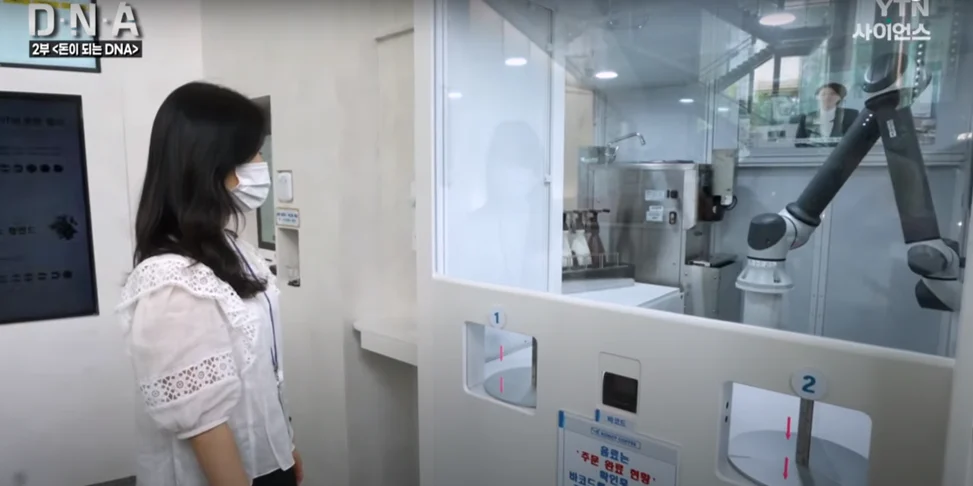
Employees often forgot credit cards heading to the in-office robotic cafeteria. They were used to frictionless authentication everywhere else (mobile pay, face unlock, airport check-in), but the cafeteria still demanded a physical card.
Before · the typical incident
Heads to the cafeteria
normal trip
No card on hand
+5 min realize & queue out
Walks back to the desk
+5 min
Returns to the cafeteria, with card
+5 min
Wasted (steps !, 2, 3)15min× ~30 incidents/day = 7.5 hrs lost org-wide, daily
Opportunity
Challenge
Card-network integration would need 2–3 years and policy changes neither side controlled.
One false charge could permanently break confidence in the whole system.
Biometric data demanded Korean PIPA compliance, explicit consent, and tight governance.
Key decision
Instead of waiting on card-network integration, we deducted the cafeteria charge directly from each employee's wages, only after biometric verification at the kiosk.
This was only possible inside an in-house system. But it delivered the same user experience (cardless payment, one tap, one second) in a fraction of the time. It also forced the responsible choice we wanted anyway: biometric data couldn't leave the building, and verification had to be explicit.
Biometric + Card integration
industry standard path
Biometric + Wage deduction
in-house path
How I built · trust-by-design
Only the employee ID crosses between systems. A breach in one couldn't compromise the other.
How the data is isolated
Biometric DB
Payroll DB
A breach in one couldn't compromise the other.
“You are [Name], purchasing [Item] for [Amount].” False payments became structurally hard, not just statistically rare.
User agency was built into the data lifecycle itself, not just the onboarding flow.
Accuracy was budgeted by the trust requirement, not by convenience. The bar is higher when money moves.
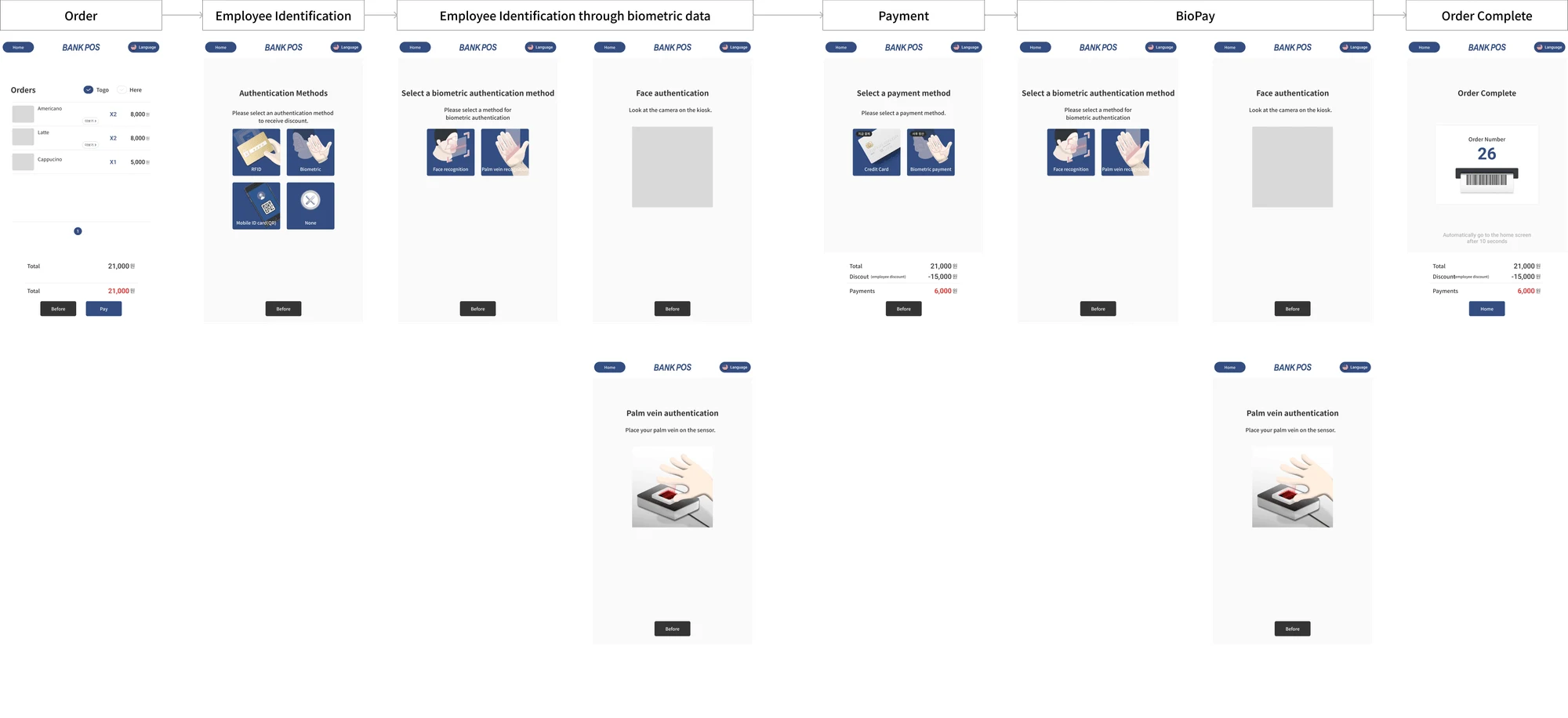
The user flow · where the architecture becomes visible
Registration
Employees enroll palm vein + face biometric data at a dedicated booth (one-time, ~3 min).
Authentication
Scan biometric (palm vein OR face) at the kiosk.
Verification
Screen shows name + purchase + amount.
Payment
Purchase amount automatically deducted from monthly payroll.
Confirmation
Receipt shows the transaction. No additional steps required.


Impacts
1,270 hours
Annual productivity recovered, org-wide15 min × ~30 incidents/day × 251 working days
0
False charges in year 1
at 99.9% authentication accuracy
2–3yr→1mo
Development timeline reduction
card-network integration vs. wage-deduction path
99.9 percent
Authentication accuracy
at an industry-compliant False Acceptance Rate
Key Takeaways
The card-network timeline forced a wage-deduction architecture that turned out to be safer and more efficient than the original plan. The on-premise privacy requirement, originally a regulatory cost, became the trust differentiator itself.